Introducing Sia CLI: the agentic command line for IT operations

Words by
Karan Singh
Co-founder & CTO
Why we built an IT-operations agent for the command line
There is a quiet gap in enterprise IT. The systems we run have never been more programmable. Every cloud, every hypervisor, every firewall, every database, every storage array, every endpoint manager ships an API. And yet the actual work of operating them has barely moved. An engineer still bounces between a dozen consoles, copies a value out of one tab and into a form in another, reads a runbook in a wiki, and finally types a command with their fingers crossed.
The intelligence to do better is sitting in our models now. What has been missing is a way to apply it that an enterprise can trust near production, and that reaches across the whole estate instead of one corner of it.
That gap is why we built Sia CLI. Before I get into what it does, I want to be plain about two decisions: why we built for IT operations as a whole, and why we put the agent in the terminal.
Here is the mission:
Sia CLI puts Scogo's IT-operations agent in the terminal, so an engineer can run work across the whole IT estate in plain language, with every action policy-gated and written to a signed audit trail.
The rest of this post is the argument behind that sentence.
The agent reaches the whole estate, not one domain
Start with the part that matters most. Sia is not a network tool. It is not a compliance tool. It is the command-line surface for SIA, Scogo's IT-operations agent, and SIA's job is the whole estate.
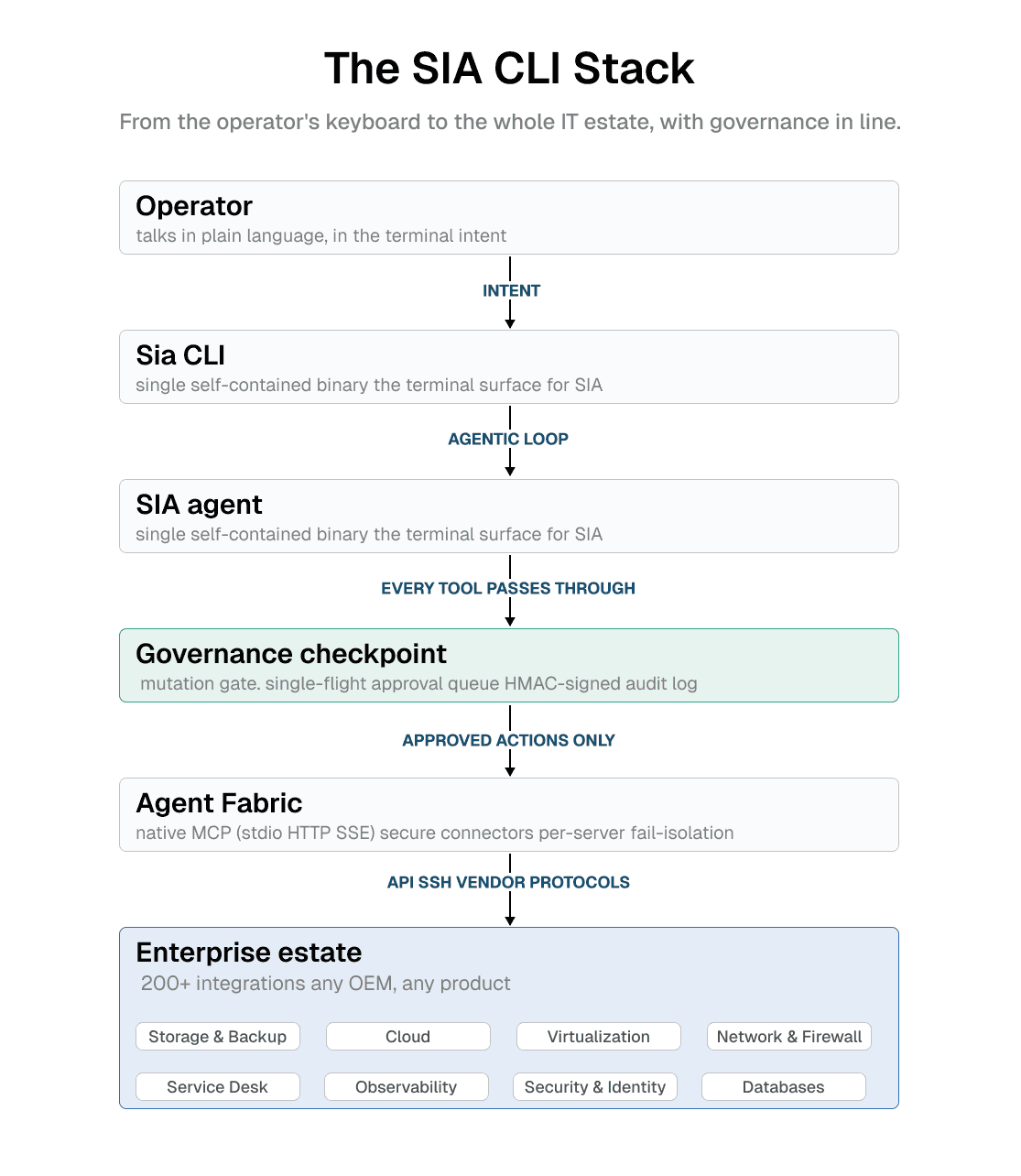
The way it gets there is Scogo's Agent Fabric, the layer that connects the agent to the systems you already run. Its like a mesh of domain agents and secure connectors that turn intent into action. The estate it spans is wide on purpose. Cloud , Storage and backup. Virtualization. Networking and firewalls. Security, from identity to email and network protection. Databases. Service desk and RMM. Monitoring and observability. Scogo connects to more than 200 systems across those categories.
So when an IT director reads "agent for IT operations," I do not want them picturing a clever script for one device family. I want them picturing the surface their whole team works against. The cloud team, the platform team, the network and security team, the storage and backup team, the helpdesk. The same agent, reachable from the same terminal, connected to the things each of those teams already owns.
That breadth is the reason the rest of this is worth doing. A narrow agent saves a narrow slice of toil. An agent that reaches the estate changes how the team works.
Why IT operations
IT operations is where automation has the most obvious value and the highest cost of getting it wrong. People usually treat those two facts as a contradiction. They are actually the opportunity.
The value is obvious because operations work is full of toil that is structured but not trivial. Triaging an alert. Pulling the current state of a system before a change. Walking a configuration against a baseline. Correlating logs in an incident window. Resetting access. Patching. Reconciling what is actually deployed against what the records say. These are multi-step jobs with real judgment in them, repeated thousands of times across an org. They are the right shape for an agent. Bounded, tool-driven, procedure-led.
The cost of getting it wrong is just as obvious. A bad change to a production firewall is not a failed test you re-run. It is an outage, or a security hole, or a 2 a.m. incident with your name on the change record. The same is true of a wrong delete on a storage array or a fat-fingered IAM policy. This is why most "AI for IT ops" stops at read-only suggestions, or a chat window that hands you a command to paste. The moment an agent could actually act, the risk changes, and most teams refuse to cross that line on faith. They are right to.
We built Sia on the belief that the line can be crossed, but only if crossing it is engineered. Bounded by policy. Gated by a human where it matters. Recorded so completely that "what did the agent do, and who approved it" is never an open question. I go deep on that machinery in a separate post. The point here is narrower. IT operations is worth solving because it is the hard case. Solve the governance, and the value follows, across every domain the agent can reach.
Why a command line
Once you decide the work is IT operations, the next question is where the agent should live. Our answer is the terminal because the command line has properties that fit infrastructure work, and several of them are exactly what an enterprise needs from an agent.
It is where the work already happens. The senior people who run production live in a shell, next to their SSH sessions, their kubectl, their git, their vendor CLIs, their jump host. An agent in the same surface joins the existing flow instead of asking the operator to switch into yet another tab. The fastest path to adoption is to meet people where they already are.
It is scriptable. A console is a destination. A CLI is a building block. The same agent an operator talks to by hand can run from a pipeline, a cron job, or a deploy hook. sia run "reconcile the asset inventory for this account" is a one-liner you can drop into CI. Composability is the native language of operations.
It reaches the places infrastructure actually lives. Bastion hosts. Air-gapped segments. A switch's management network. A server with nothing open but SSH. These are real environments where a heavy GUI is a non-starter, but a single self-contained binary is at home. Sia ships as exactly that, one compiled binary per platform, with no runtime install dance on the box.
It is fast. Operations is often time-critical. During an incident, the distance between "I have a question" and "I have an answer" matters. A prompt in a terminal you already have open, streaming results as the agent works, is about as short as that distance gets.
And it is legible. A command line is a sequence of explicit, recordable events. Every prompt, every tool call, every result is a discrete thing you can show, log, and reason about. When you put an agent in the loop, that legibility is the ground governance is built on. It is far easier to prove what a terminal-native agent did than to reconstruct the behavior of an automation buried in a UI.
Put those together. For managing infrastructure in an enterprise, the command line is not a fallback. It is the right interface. It is where operators work, it composes into the systems around it, it reaches where infrastructure lives, and it is auditable by nature, which is the thing that lets an agent act at all.
What Sia CLI is
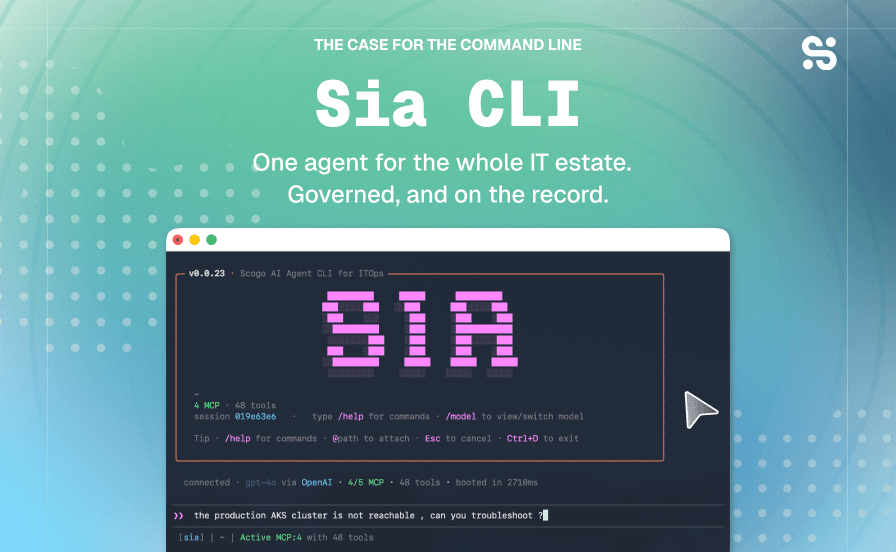
Sia CLI, the sia binary, is the keyboard surface for SIA. You talk to it in plain language. It reads files and runs commands locally. It connects to the systems you already operate through the Model Context Protocol and through Agent Fabric. And it does multi-step operational work the way a good senior engineer would. Investigate before acting. Preview changes. Verify its own work before it calls a job done.
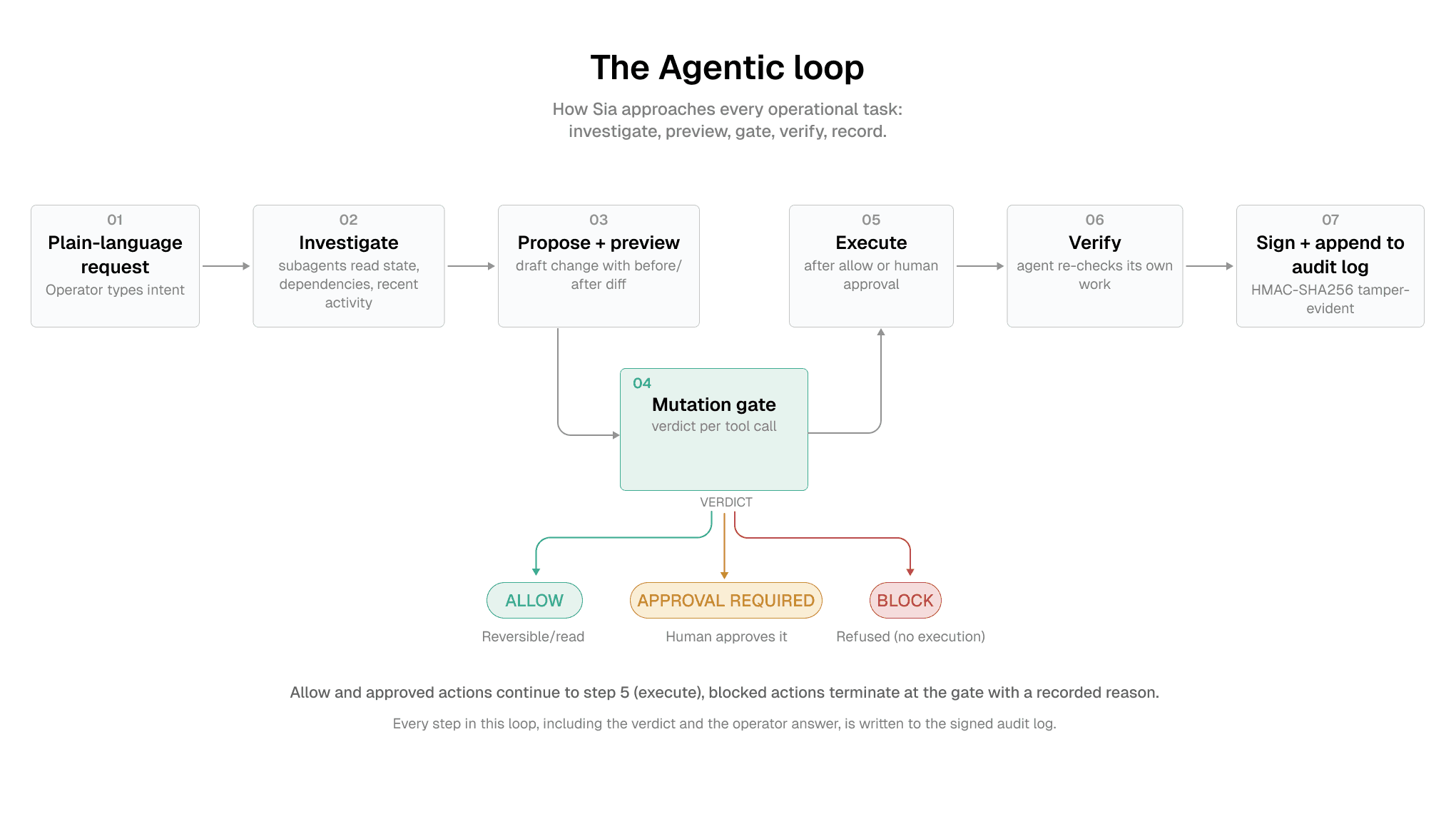
Three things make it credible for an enterprise, and I take each one apart properly in the governance post.
It is governed. A policy layer checks every action the agent tries and decides whether it runs freely, needs a human's approval, or is blocked outright. The worst foot-guns, like a recursive force-delete of a protected path, are refused, not warned about.
It is on the record. Every session, prompt, policy decision, approval, and tool call is written to a signed, append-only audit log. The log is tamper-evident, and you can export it and verify it as compliance evidence.
It is grounded in your estate. Native MCP and Agent Fabric mean the agent acts against your systems, across cloud, OS, storage, backup, network, security, and databases, over standard transports, validated before you ever open the session.
Autonomy where it is safe, a human gate where it matters, a complete record everywhere. That is what turns "an AI that could touch production" from a liability into something an operations team can actually use.
Where this is going
We built Sia CLI for the people who keep production running and the leaders accountable for it. The mission is the same one I opened with. An IT-operations agent that reaches the whole estate, in the terminal your team already uses, autonomous where it is safe, governed where it matters, on the record everywhere.
Sia CLI is part of the Scogo platform we deliver to our enterprise customers. If you are running a large IT estate and the gap between "the systems are programmable" and "the work has not changed" is one you feel every week, that is the conversation I want to have.
Sia CLI is the command-line interface for the Scogo AI platform, the terminal surface for SIA. Available to Scogo enterprise customers.